Showing posts with label Nature. Show all posts

Friday, January 25, 2013

Udawalawe National Park


Udawalawe National Park lies on the boundary of Sabaragamuwa and Uva Provinces, in Sri Lanka. The national park was created to provide a sanctuary for wild animals displaced by the construction of the Udawalawe reservoir on the Walawe River, as well as to protect the catchment of the reservoir. The reserve covers 30,821 hectares (119.00 sq mi) of land area and was established on 30 June 1972.[1] Before the designation of the national park, the area was used for shifting cultivation (chena farming). The farmers were gradually removed once the national park was declared. The park is 165 kilometres (103 mi) from Colombo. Udawalawe is an important habitat for water birds and Sri Lankan Elephants. It is a popular tourist destination and the third most visited park in the country

Wednesday, January 23, 2013

Sinharaja Forest Reserve

Sinharaja Forest Reserve is a national park and a biodiversity hotspot in Sri Lanka. It is of international significance and has been designated a Biosphere Reserve and World Heritage Site by UNESCO.
The hilly virgin rainforest, part of the Sri Lanka lowland rain forests ecoregion, was saved from the worst of commercial logging by its inaccessibility, and was designated a World Biosphere Reserve in 1978 and a World Heritage Site in 1988. The reserve's name translates as Kingdom of the Lion.
The reserve is only 21 km (13 mi) from east to west, and a maximum of 7 km (4.3 mi) from north to south, but it is a treasure trove of endemic species, including trees, insects, amphibians, reptiles, birds and mammals.
Because of the dense vegetation, wildlife is not as easily seen as at dry-zone national parks such as Yala. There are about 3 elephants and the 15 or so leopards are rarely seen. The most common larger mammal is the endemic Purple-faced Langur.
An interesting phenomenon is that birds tend to move in mixed feeding flocks, invariably led by the fearless Greater Racket-tailed Drongo and the noisy Orange-billed Babbler. Of Sri Lanka's 26 endemic birds, the 20 rainforest species all occur here, including the elusive Red-faced Malkoha, Green-billed Coucal and Sri Lanka Blue Magpie.
Reptiles include the endemic Green pit viper and Hump-nosed vipers, and there are a large variety of amphibians, especially tree frogs. Invertebrates include the endemic Common Birdwing butterfly and the inevitable leeches

Hummanaya Blowhole - Tangalle

In geology, a blowhole is formed as sea caves grow landwards and upwards into vertical shafts and expose themselves towards the surface, which can result in blasts of water from the top of the blowhole[1] if the geometry of the cave and blowhole and state of the weather are appropriate.
A blowhole is also the name of a rare geologic feature in which air is blown through a small hole at the surface due to pressure differences between a closed underground system and the surface. The blowholes of Wupatki National Monument are an example of such a phenomenon. It is estimated that the closed underground passages have a volume of at least seven billion cubic feet. Wind speeds can approach 30 miles per hour.[2]

Pinnawala Eliphant Orphanage


The Pinnawela Elephant Orphanage is situated northwest of the town of Kegalle, halfway between the present commerciel capital Colombo and the ancient royal residence Kandy in the hills of central Sri Lanka. There are about 84 elephants under protection. The orphanage is visited daily by many Sri Lankan and foreign tourists.


Horton Plains National Park


Horton Plains National Park is a protected area in the central highlands of Sri Lanka and is covered by montane grassland and cloud forest. This plateau at an altitude of 2,100–2,300 metres (6,900–7,500 ft) is rich in biodiversity and many species found here are endemic to the region. This region was designated a national park in 1988. It is also a popular tourist destination and is situated 32 kilometres (20 mi) from Nuwara Eliya and 8 kilometres (5.0 mi) from Ohiya

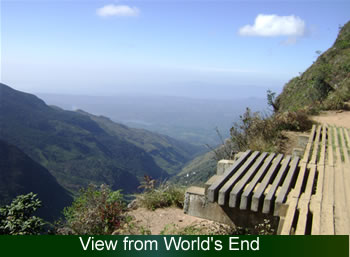
The Horton Plains are the headwaters of three major Sri Lankan rivers, the Mahaweli, Kelani, and Walawe. In Sinhala the plains are known as Maha Eliya Plains. Stone tools dating back to Balangoda culture have been found here. The plains' vegetation is grasslands interspersed with montane forest, and includes many endemic woody plants. Large herds of Sri Lankan Sambar Deer feature as typical mammals, and the park is also an Important Bird Area with many species not only endemic to Sri Lanka but restricted to the Horton Plains. Forest dieback is one of the major threats to the park and some studies suggest that it is caused by a natural phenomenon. The sheer precipice of World's End and Baker's Falls are among the tourist attractions of the park.


Tuesday, December 25, 2012

Kumana National Park (Bird Santuary)


Kumana National Park in Sri Lanka is renowned for its avifauna, particularly its large flocks of migratory waterfowl and wading birds. The park is 391 kilometres (243 mi) southeast of Colombo on Sri Lanka's southeastern coast. Kumana is contiguous with Yala National Park. Kumana was formerly known as Yala East National Park, but changed to its present name in 5 September 2006.

Monday, November 12, 2012

Dunhinda Waterfall - Sri Lanka

Dunhinda Waterfall

Dunhinda Falls is a waterfall located about 5 kilometres (3.1 mi) from Badulla town in Sri Lanka.The Dunhinda Falls is one of Sri Lanka's most beautiful waterfalls.The waterfall, which is 210 feet (64 m) high gets its name from the smoky dew drops spray, (Dun in sinhala means mist or smoke) which surrounds the area at the foot of the waterfall. The water fall is created by the river called Badulu Oya which goes through the Badulla town.
To reach the water fall you have to walk more than 1 km distance along a foot path. Along this foot path you can see another small waterfall called Kuda Dunhinda at a distance. However walking along this muddy foot path is really worth as the waterfall is so beautiful. Along this foot path there are many native venders selling herbal drinks to refresh and rest yourself. At the end of the path there is a secure stage constructed for viewers to see the waterfall. If you are brave enough you can reach the foot of the waterfall and cross the river and see the most beautiful view of the fall.


from Wikipedia